

15 Best Online Interior Design Courses for Complete Beginners

These days, the interior design industry has grown steadily. According to Data USA, the number of active interior designers increased from 76,907 in 2018 to 95,487, while the average annual salary ranges from $61,830 to $72,010, making it an attractive and rewarding career option.
If you're passionate about home or interior design and want to become an interior designer—whether part-time or full-time—this guide is perfect for you. 15 of the best online interior design courses for beginners in 2026 are handpicked, covering each course's strengths, weaknesses, pricing, and who it's best for, so you can quickly find the right one for your goals.
While learning these interior design courses, also do not forget to practice and improve your design skills by try our free AI interior design tool.
Design any room, shop or space with DecAI in less 30 seconds! It's free!
What to Look for in a Beginner Interior Design Course?
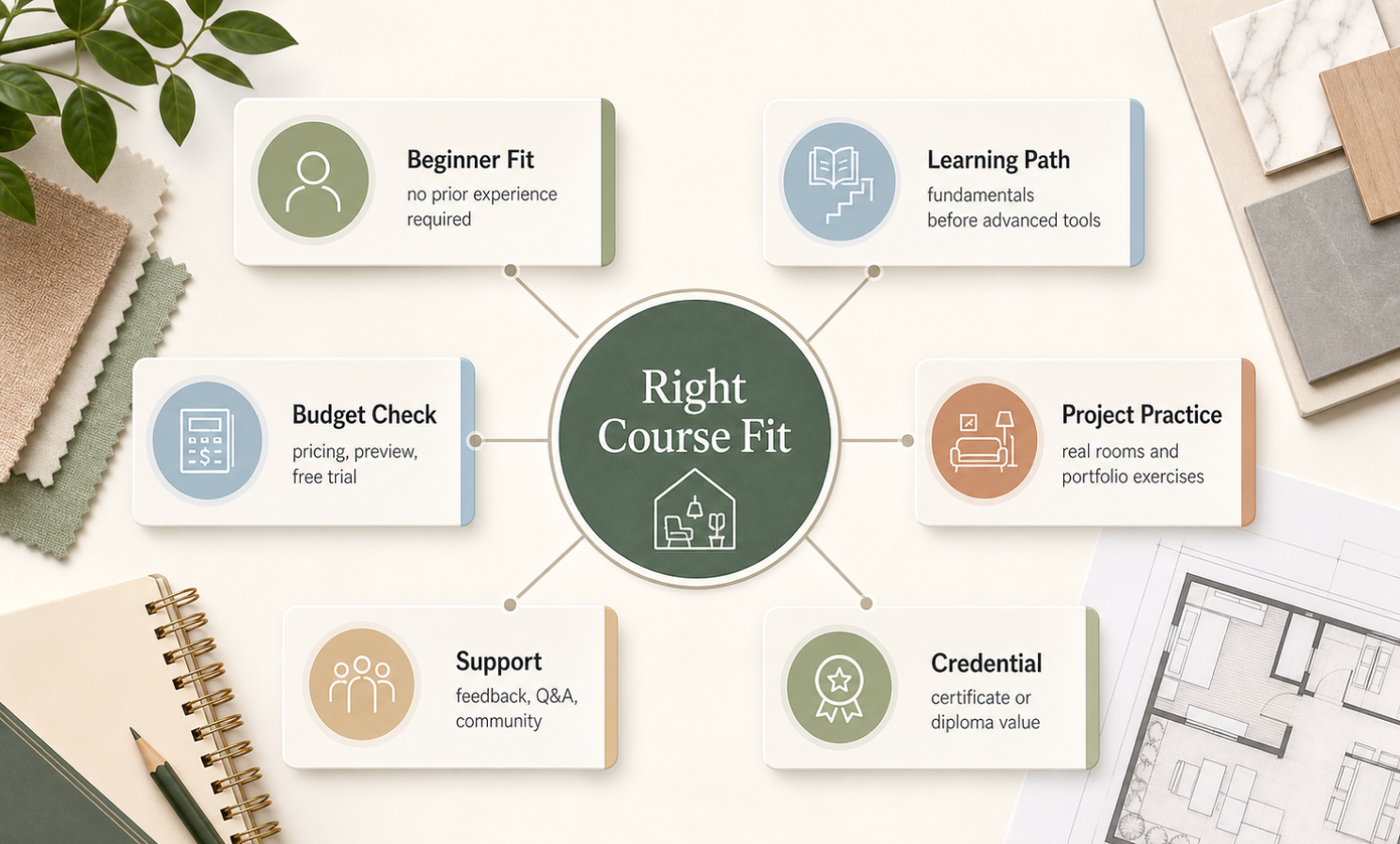
A polished course page or an impressive certificate doesn't always mean a course is beginner-friendly. Before enrolling, consider these key factors:
- Beginner-friendly content: Some platforms mix beginner and advanced content in the same course, which can be overwhelming if you're starting from zero.
- Clear learning path: Lessons should progress logically from fundamentals to more advanced topics.
- Practical projects: Look for assignments that let you apply what you learn to real spaces.
- Course format: Choose a format that fits your schedule, whether self-paced, live, certificate, diploma, or membership-based.
- Portfolio or project value: Stronger courses include assignments, design exercises, or visual outputs, which would help you create a much better portfolio later.
- Design software: Check whether the course introduces tools like SketchUp, AutoCAD, Revit, or AI-powered design platforms such as DecAI™.
- Design theory: Make sure it covers essential topics like color, space planning, lighting, materials, and furniture layout.
- Instructor quality: Experienced designers with real-world projects often provide more practical insights.
- Student support: Feedback, Q&A sessions, discussion forums, or community access can greatly improve the learning experience.
- Certification: Consider whether earning a certificate matters for your goals.
- Pricing: Compare the value offered and avoid overspending before you're sure interior design is right for you.
- Free preview: A free trial, sample lesson, preview video, or audit option lets you evaluate the teaching style before committing.
- Reviews and ratings: Read feedback from previous students to understand the course's strengths and weaknesses.
- Updated content: Interior design trends, software, and AI tools evolve quickly, so choose a course that's regularly updated.
In short, the best course isn't necessarily the most expensive or the one with the biggest name—it's the one that matches your experience level, learning style, budget, and career goals.
15 Best Online Interior Design Courses for Complete Beginners
1. VDCI Intro to Interior Design
Best for: Complete beginners who want a structured first step into interior design.
Platform/provider: VDCI
What beginners learn:
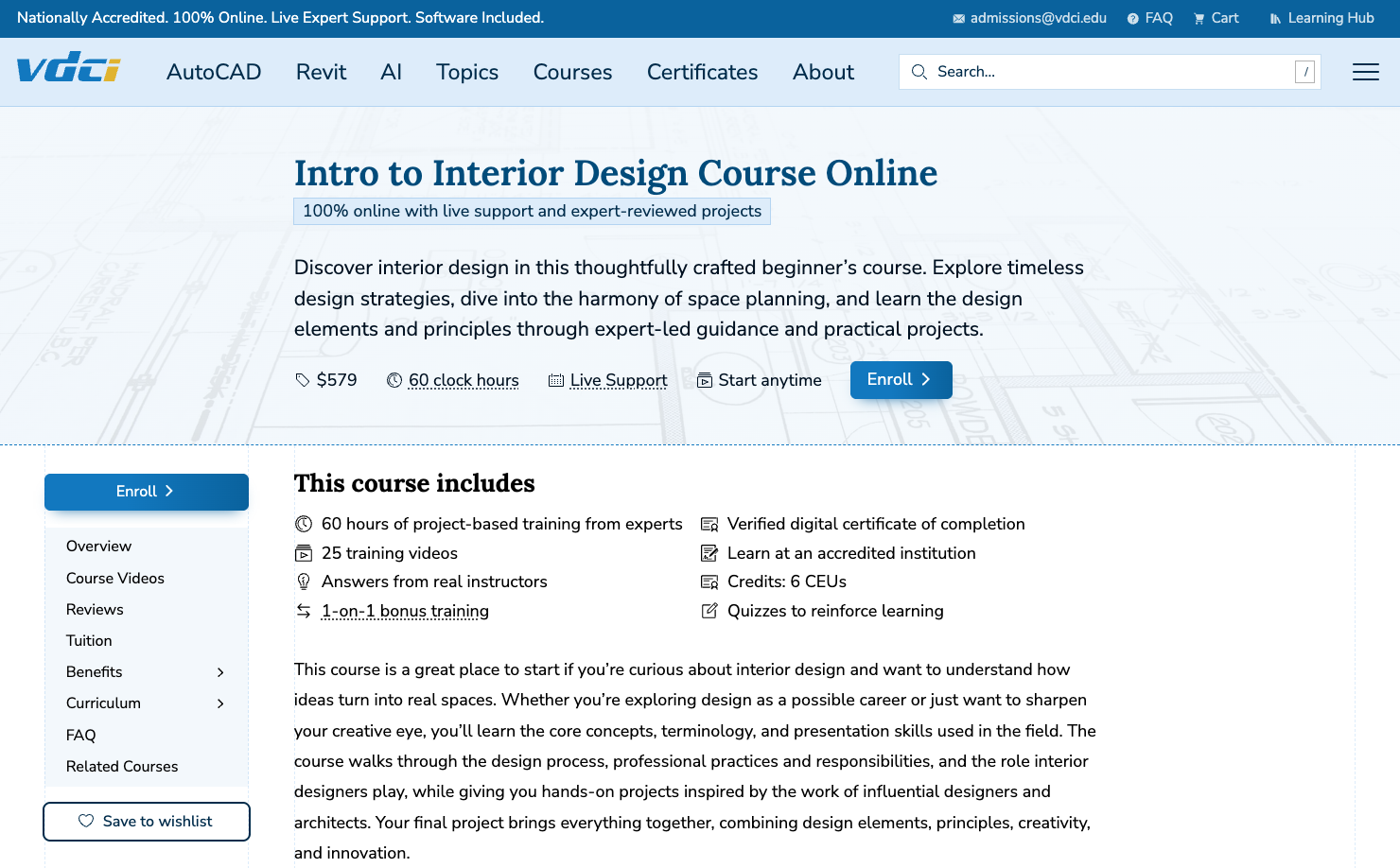
VDCI’s Intro to Interior Design course is a strong starting point for learners who want more than casual decorating tips. It introduces core interior design ideas such as space planning, color, materials, lighting, furniture selection, and the design process.
Instead of only showing what a finished room should look like, the course helps beginners understand how designers make decisions from the start of a project.
Time commitment:
This is a medium-commitment course. It is more structured than a short video class, so it works best for learners who are ready to study interior design in a more organized way.
Certificate or credential:
A course completion credential may be available.
Why choose it:
Choose this course if you want a serious foundation before moving into tools like SketchUp, AutoCAD, or Revit. It is especially useful for beginners who may later consider a certificate program, portfolio work, or interior design as a career path.
What to watch out for:
If your only goal is to refresh one bedroom or living room quickly, this may feel more formal than necessary. In that case, a shorter Udemy, Skillshare, or Domestika class may be easier to start with.
2. Alison Diploma in Interior Design

Best for: Beginners who want a free diploma-style introduction to interior design.
Platform/provider: Alison
What beginners learn:
Alison’s Diploma in Interior Design is a useful low-risk option for people who want to explore the subject before paying for a larger course. It introduces basic design principles, room planning, decorating concepts, color, and interior design vocabulary. For a complete beginner, this can help turn vague interest into a clearer understanding of what interior design actually involves.
Time commitment:
The course is self-paced, so it is easy to fit around work, school, or home projects.
Certificate or credential:
The learning content is typically free to access, while certificate options may require payment.
Why choose it:
Choose Alison if you want to test your interest first. It is a smart first step if you are not yet sure whether you want interior design as a hobby, a side skill, or a possible career.
What to watch out for:
Free courses usually do not offer the same level of instructor feedback, portfolio review, or project support as paid certificate programs. Treat it as an introduction, not a complete professional pathway.
3. Oxford Home Study Interior Decoration Course
Best for: Beginners who want to understand home decoration and styling basics.
Platform/provider: Oxford Home Study Centre
What beginners learn:
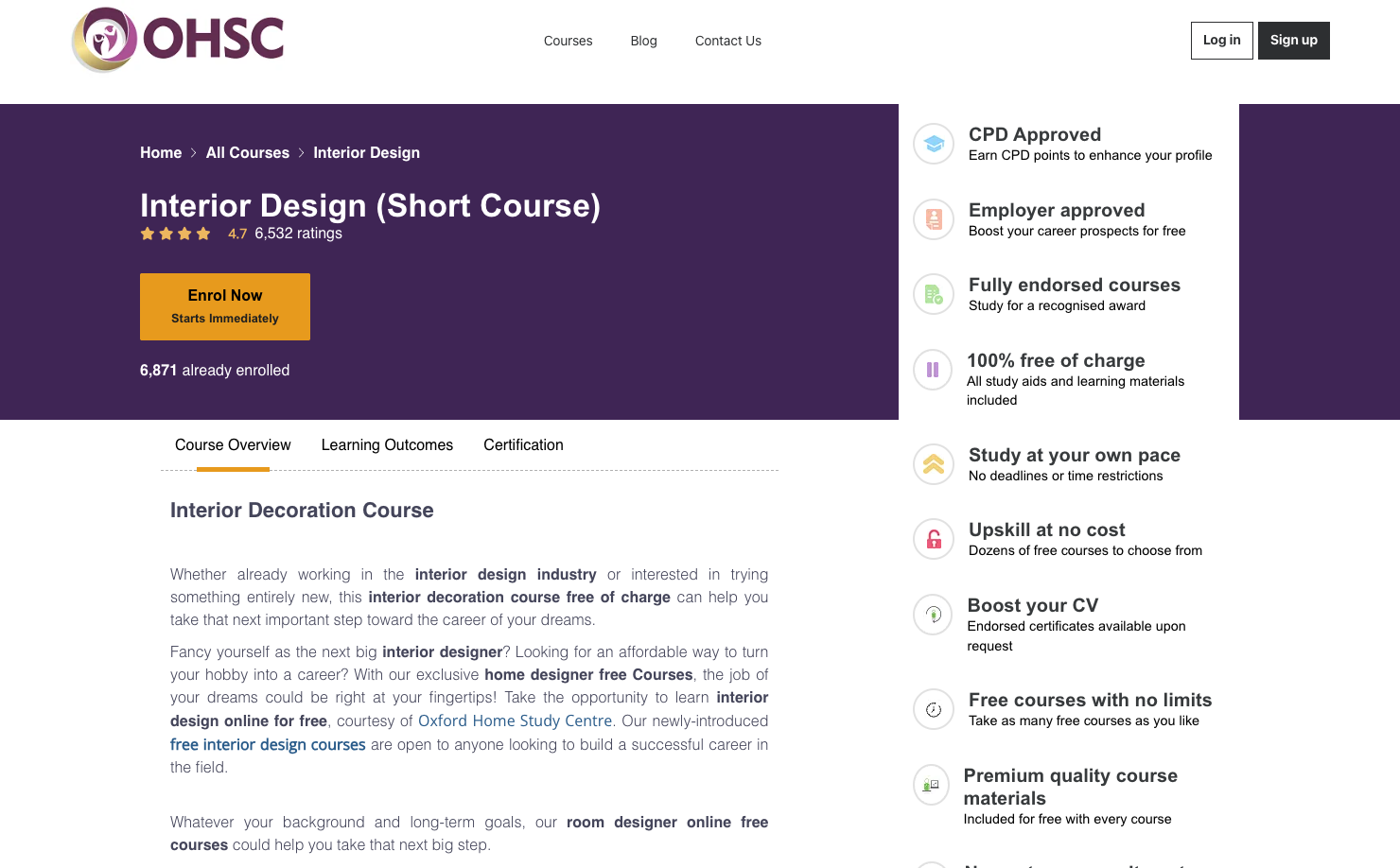
This Oxford home study interior decoration course is especially helpful for learners who are more interested in decorating than technical interior design. It covers basic decorative principles, color, style, presentation, and how different choices affect the mood of a room. If you often save design inspiration but struggle to apply it in your own home, this course can help you organize your ideas.
Time commitment:
It is self-paced and beginner-friendly, making it a good option for casual learners.
Certificate or credential:
An optional certificate may be available depending on the current course terms.
Why choose it:
Choose this course if you want a free and simple way to start learning how rooms are styled. It is especially suitable for homeowners, renters, and hobby learners.
What to watch out for:
Interior decoration is not the same as full interior design. If you want to learn technical drawings, professional space planning, or client project workflows, you will need a more advanced course later.
4. Udemy: How to Design a Room in 10 Easy Steps
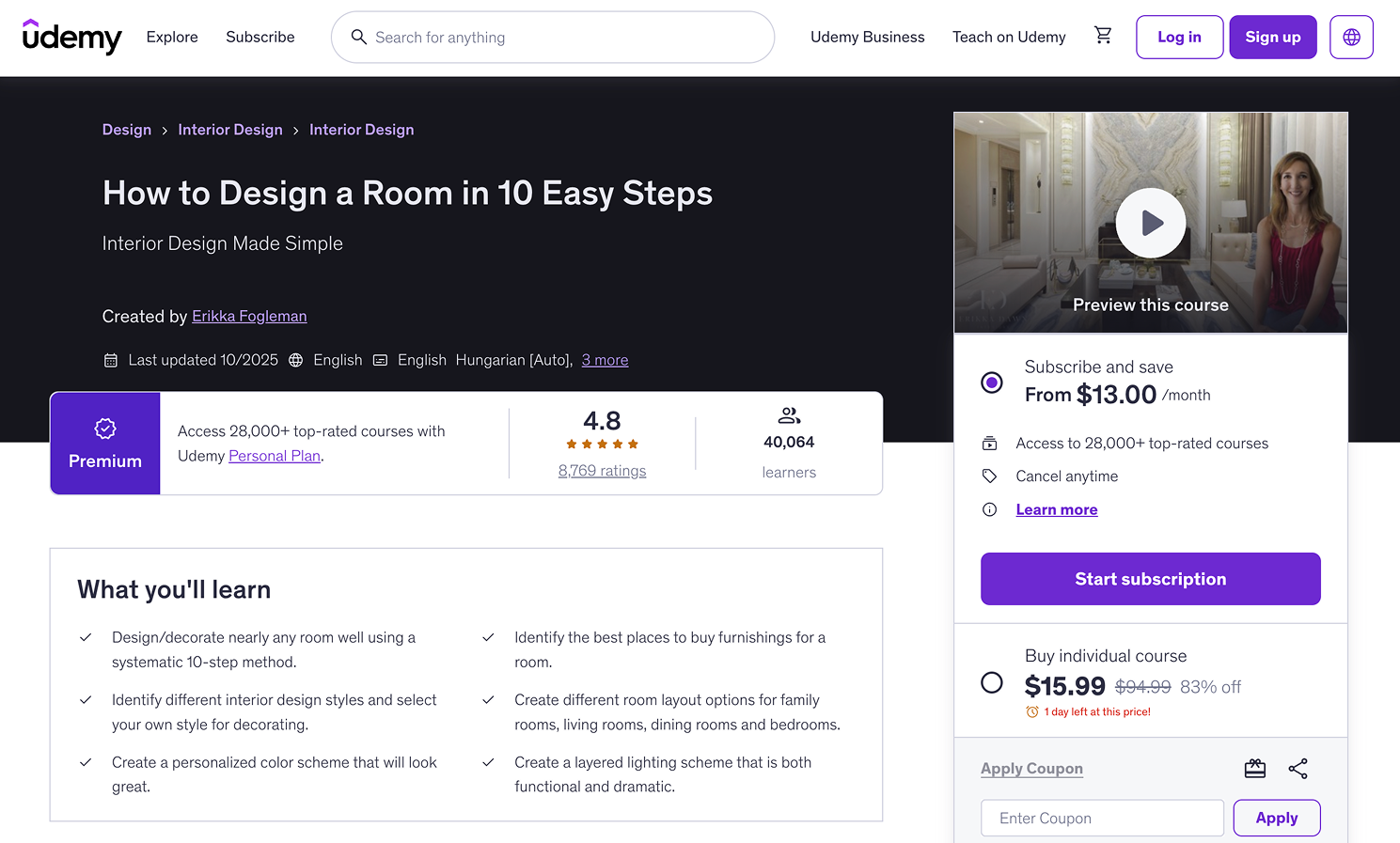
Best for: Beginners who want to redesign one real room.
Platform/provider: Udemy
What beginners learn:
This Udemy's online course is practical because it gives beginners a clear room-design process. Instead of overwhelming learners with too much theory, it focuses on decisions you can actually make in a real space: how to plan the room, choose a direction, think about furniture, use color, and bring the design together. That makes it especially useful if you already have a bedroom, living room, office, or rental space you want to improve.
Time commitment:
It is a short, self-paced course, so it is easy to complete without a large time commitment.
Certificate or credential:
Udemy provides a certificate of completion.
Why choose it:
Choose this course if you want quick, practical progress. It is one of the better choices for beginners who want to stop guessing and follow a simple step-by-step process.
What to watch out for:
It is not designed to replace a full interior design certificate or diploma. Think of it as a first project course rather than professional training.
5. Udemy: Interior Design for Beginners
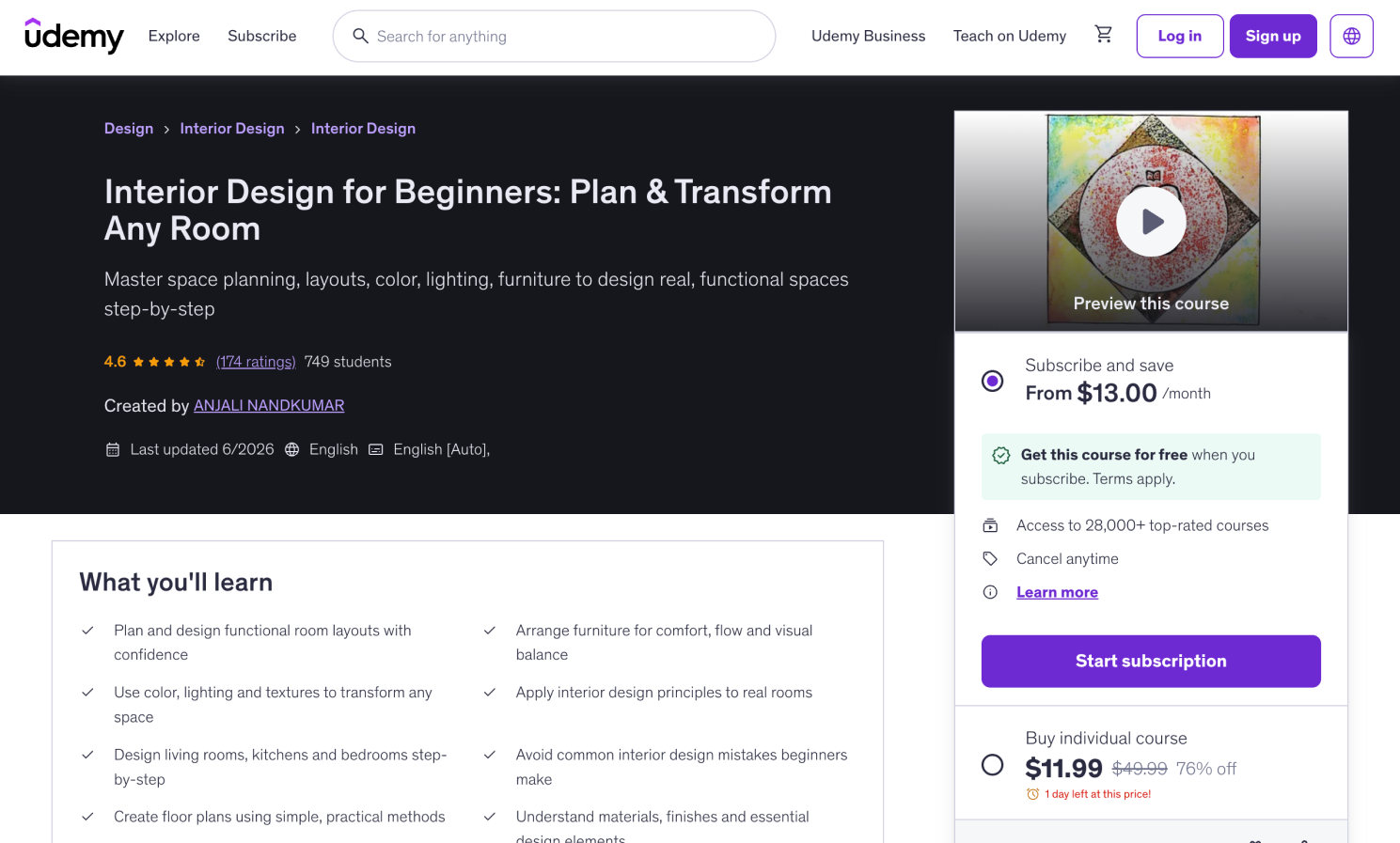
Best for: Beginners who want affordable practical fundamentals.
Platform/provider: Udemy
What beginners learn:
This interior design course is designed for learners who want to understand how to plan and transform a room without needing prior experience. It covers beginner-friendly ideas around layout, decorating, styling, and room improvement. The appeal is that it keeps the learning practical, so you can connect each lesson to your own home instead of studying design as an abstract subject.
Time commitment:
It is self-paced and usually easier to complete than a formal certificate program.
Certificate or credential:
Udemy provides a certificate of completion.
Why choose it:
Choose it if you want an affordable first course and prefer flexible learning. It is a good fit for beginners who want a mix of design basics and real-room application.
What to watch out for:
Udemy pricing and course content can change. Before enrolling, check the latest curriculum, preview videos, instructor background, and student reviews.
6. Domestika: Interior Design for Beginners
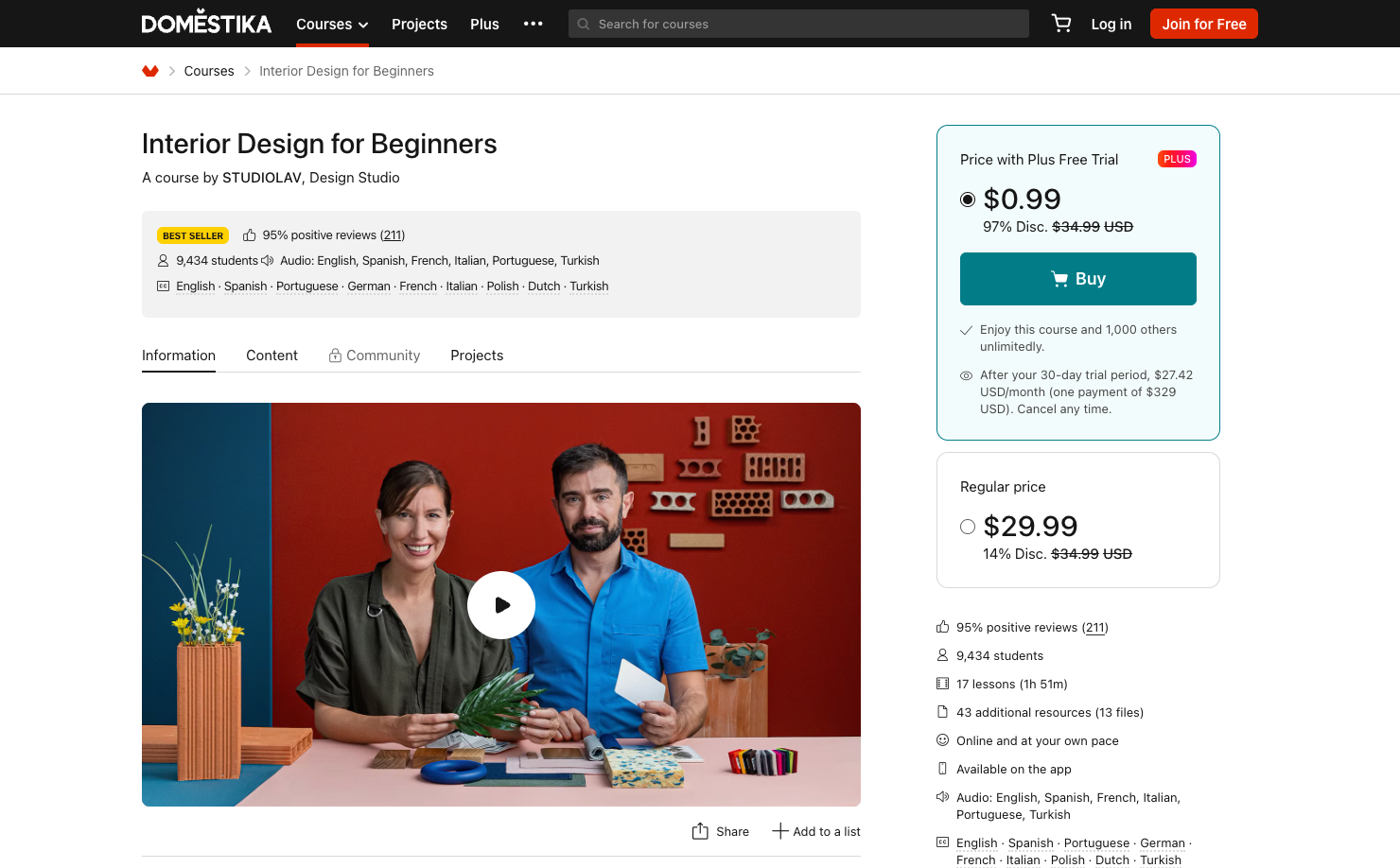
Best for: Creative beginners who learn best through visual projects.
Platform/provider: Domestika
What beginners learn:
Domestika’s Interior Design for Beginners course is a strong option if you want a visual and project-based learning experience. It helps beginners think about concept, atmosphere, mood boards, materials, and how a room communicates a feeling. This is useful because many beginners collect inspiration images but do not know how to turn them into one coherent design direction.
Time commitment:
It is a short to medium self-paced course.
Certificate or credential:
A Domestika certificate option may be available.
Why choose it:
Choose Domestika if you want a more creative introduction to interior design. It is especially helpful for learners who care about mood, storytelling, and visual presentation.
What to watch out for:
It is stronger for creative development than formal career credentialing. If your goal is professional interior design work, pair it with a more structured course later.
7. Skillshare: Easy Interior Design

Best for: Beginners who want a quick lesson on layout, function, and flow.
Platform/provider: Skillshare
What beginners learn:
This Skillshare class focuses on one of the most important beginner lessons: a room needs to work before it can look good. Beginners learn how to think about movement, furniture placement, function, and how people actually use a space. That makes it a useful course if your room looks decent but still feels awkward or uncomfortable.
Time commitment:
It is a short class and can be completed quickly through Skillshare access.
Certificate or credential:
Skillshare may show class completion, but it is not a formal interior design credential.
Why choose it:
Choose this course if you want a fast and practical introduction to layout thinking. It is a good early course before you start buying furniture or decor.
What to watch out for:
Skillshare uses a membership model, so check current access and pricing before joining. This is also a focused class, not a complete interior design program.
8. MasterClass: Kelly Wearstler Teaches Interior Design

Best for: Beginners who want to develop style, taste, and design confidence.
Platform/provider: MasterClass
What beginners learn:
Kelly Wearstler’s MasterClass is less about technical instruction and more about how a designer sees a space. Beginners can learn about materials, contrast, scale, color, texture, storytelling, and how bold design choices come together. It is especially valuable for learners who want to move beyond copying Pinterest images and start building their own design eye.
Time commitment:
It is self-paced and can be completed as part of a MasterClass membership.
Certificate or credential:
MasterClass does not provide a traditional professional interior design certificate.
Why choose it:
Choose this class if you want inspiration from a highly recognized designer and want to understand design thinking at a higher level.
What to watch out for:
Design any room, shop or space with DecAI in less 30 seconds! It's free!
It is not assignment-heavy or technical. If you need hands-on practice, pair it with a project-based or fundamentals course.
9. MasterClass: Corey Damen Jenkins Teaches Interior Design

Best for: Beginners who want to use color, pattern, and personality with more confidence.
Platform/provider: MasterClass
What beginners learn:
Corey Damen Jenkins’ course is useful for learners who want interiors that feel expressive rather than generic. Beginners can learn how bold color, pattern, and decorative choices can still feel balanced when guided by proportion and intention. This is especially helpful if you like layered interiors but worry about making a room feel too busy.
Time commitment:
It is self-paced through MasterClass access.
Certificate or credential:
No traditional professional certificate is provided.
Why choose it:
Choose this class if you want to build a stronger personal design voice. It can help beginners understand how confidence and control work together in interior design.
What to watch out for:
It should not be your only course if you want technical interior design training. Use it for inspiration and style development, then study fundamentals separately.
10. MasterClass: Shea McGee Design a Space You Love
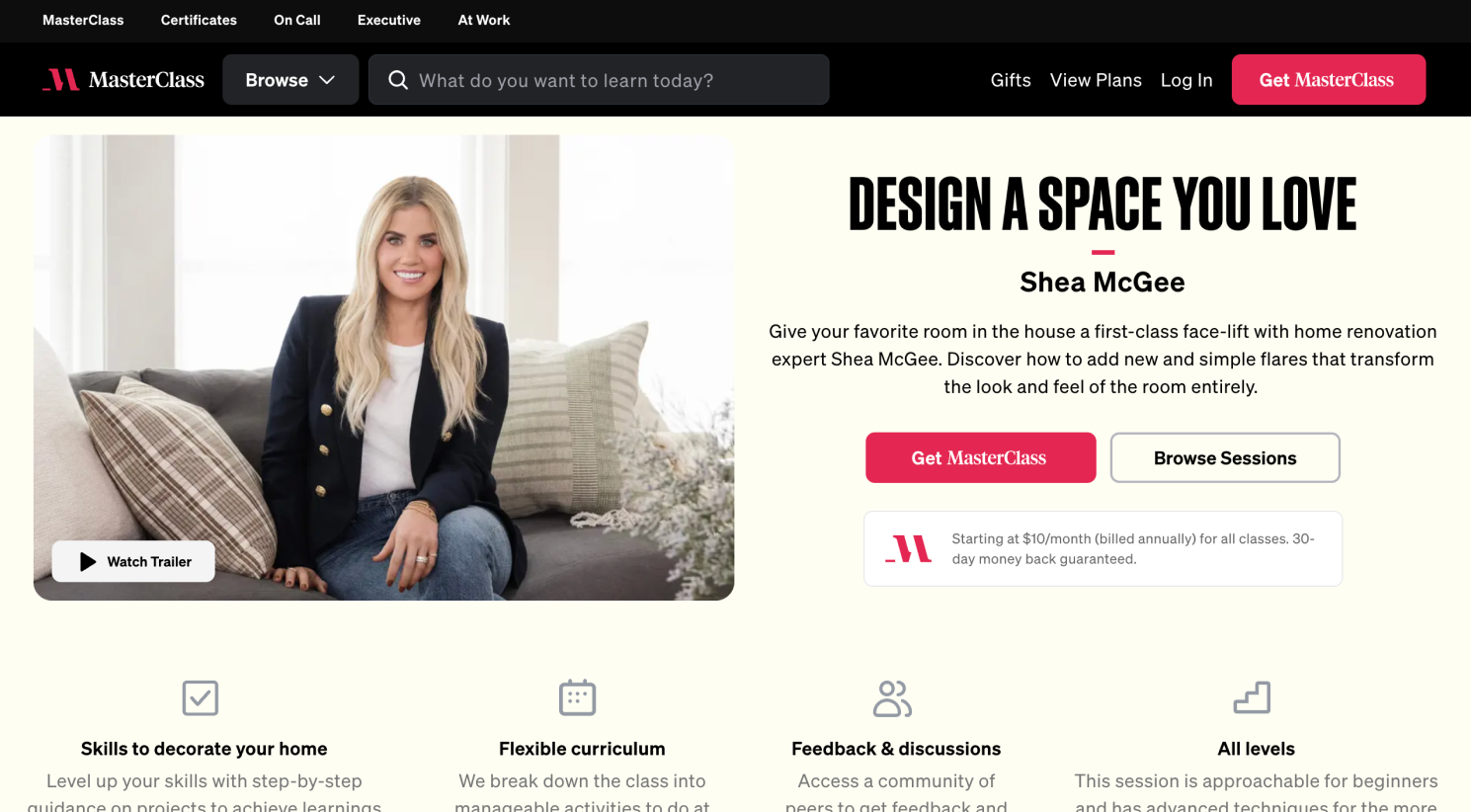
Best for: Homeowners and renters who want a polished, livable room makeover process.
Platform/provider: MasterClass
What beginners learn:
Shea McGee’s class is approachable for beginners because it focuses on designing a home that feels cohesive and livable. Learners can pick up ideas about room planning, palettes, furniture selection, styling, and creating a finished look. It is especially useful if your goal is not to become a professional designer right away, but to make your own home feel more considered.
Time commitment:
It is a short guided class format through MasterClass.
Certificate or credential:
No traditional professional certificate is provided.
Why choose it:
Choose this class if you want an accessible home-design workflow from a designer known for polished, approachable interiors.
What to watch out for:
It is not built as a professional credential. Career-minded learners should treat it as supplementary inspiration.
11. NYIAD Online Interior Design Course

Best for: Beginners considering interior design as a career path.
Platform/provider: New York Institute of Art and Design
What beginners learn:
NYIAD’s Online Interior Design Course is more career-oriented than short marketplace classes. Beginners can learn interior design fundamentals, room planning, presentation, materials, color, layout, and client-style project thinking. It is a better fit for learners who want to move from interest to structured training.
Time commitment:
This is a larger self-paced commitment than most short beginner courses.
Certificate or credential:
A certificate is available after completion.
Why choose it:
Choose NYIAD if you want more credibility, structure, and professional direction. It is a strong option for learners who may want to start a design business, work with clients, or build a portfolio.
What to watch out for:
It may be more than you need if your goal is simply to decorate your own home. Casual learners may want to start with a shorter course first.
12. The Interior Design Institute Online Course

Best for: Beginners who want a tutor-supported diploma-style course.
Platform/provider: The Interior Design Institute
What beginners learn:
The Interior Design Institute offers a more substantial self-paced course for learners who want guided study. Beginners can learn design principles, space planning, lighting, color, finishes, furniture, presentation, and client-focused design thinking. The course is useful because it gives learners a path to follow instead of leaving them to piece together random videos.
Time commitment:
It is a medium to high commitment compared with short online courses.
Certificate or credential:
A diploma-style credential is available.
Why choose it:
Choose this course if you want structure, tutor support, and a more serious learning experience without attending a traditional design school.
What to watch out for:
It requires more consistency and motivation than a short class. Make sure you are ready for assignments and a longer study timeline.
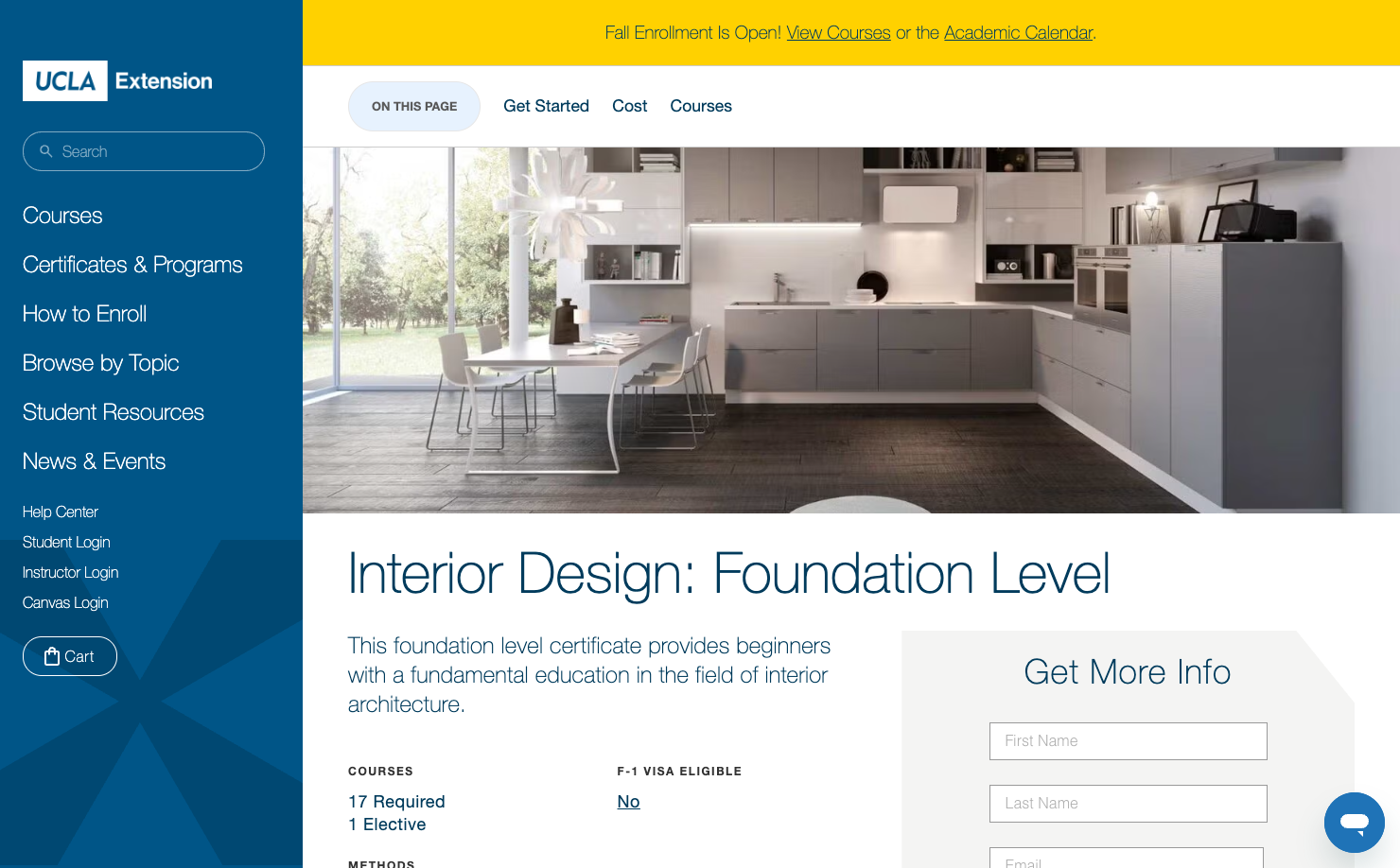
13. UCLA Extension Interior Design: Foundation Level
Best for: Serious beginners who want an academic foundation.
Platform/provider: UCLA Extension
What beginners learn:
UCLA Extension’s foundation-level interior design path is suitable for learners who want to study interior design in a more formal academic setting. It can introduce foundational design concepts, design communication, materials, space planning, and professional preparation. This is a stronger choice for someone thinking beyond casual decorating.
Time commitment:
This is a higher-commitment option compared with marketplace courses.
Certificate or credential:
It is part of a foundation-level certificate path.
Why choose it:
Choose UCLA Extension if you want university-level structure and may later pursue more advanced interior design study.
What to watch out for:
It is likely to require more time, planning, and budget than beginner hobby courses. It may be too formal if you only want a simple home makeover.
14. Moore College Interior Design Studies Certificate

Best for: Beginners who want a certificate connected to a design-school environment.
Platform/provider: Moore College of Art & Design
What beginners learn:
Moore College’s Interior Design Studies Certificate can help beginners build a foundation in interior design through a more structured creative program. Learners may study design thinking, space planning, visual communication, and project development. It is a good bridge between casual learning and more serious design education.
Time commitment:
The time commitment may vary depending on the current schedule and course format.
Certificate or credential:
Certificate program.
Why choose it:
Choose Moore if you want a design-school connection and a more credible learning path than standalone short courses.
What to watch out for:
Check current availability, schedule, online format, and requirements before enrolling. Certificate programs can change by term.
15. MassArt Interior Design Certificate

Best for: Beginners who want a structured certificate from an art and design school.
Platform/provider: Massachusetts College of Art and Design
What beginners learn:
MassArt’s Interior Design Certificate is a useful option for learners who want a more formal design-school experience. Beginners can build knowledge in design process, visual communication, materials, interior design fundamentals, and project-based thinking. It is better suited to someone who wants structured learning than someone looking for a quick decorating class.
Time commitment:
This is a medium to high commitment and may involve scheduled classes.
Certificate or credential:
Certificate program.
Why choose it:
Choose MassArt if you want a respected art-school environment and a more serious certificate-style path.
What to watch out for:
It may be less flexible than fully self-paced platforms like Udemy, Skillshare, or Domestika. Always confirm the current online format, schedule, tuition, and enrollment requirements before making a decision.
Want to learn more? Follow our step-by-step guide on how to become an interior designer, from learning essential skills to building your career. Some useful interior design blogs also give you more clues to learn better and faster.
Which Course Should You Take First?
The best course depends on what you want to do after learning. A complete beginner should not automatically choose the most expensive or most formal program. Start with your actual goal.
- If you want to redesign your own home, start with a practical room-design course. Udemy, Skillshare, Domestika, or Shea McGee’s MasterClass can help you make better choices without overloading you with professional theory.
- If you want to test interior design before spending money, start with Alison or Oxford Home Study. Free courses are useful because they help you learn basic terms and decide whether the subject genuinely interests you.
- If you want a certificate for credibility, look at NYIAD, The Interior Design Institute, UCLA Extension, Moore College, or MassArt. These programs are better if you want structured study, assignments, and a more serious learning path.
- If you want to become a professional interior designer, do not rely on short inspiration classes alone. Start with fundamentals, then move into space planning, drafting, presentation, materials, lighting, codes, and software.
- If you want to learn software, wait until you understand design basics. SketchUp, AutoCAD, Revit, 3ds Max, and rendering tools are powerful, but they will not teach you why a layout works or why a room feels balanced.

From Learning the Basics to Designing Your First Room
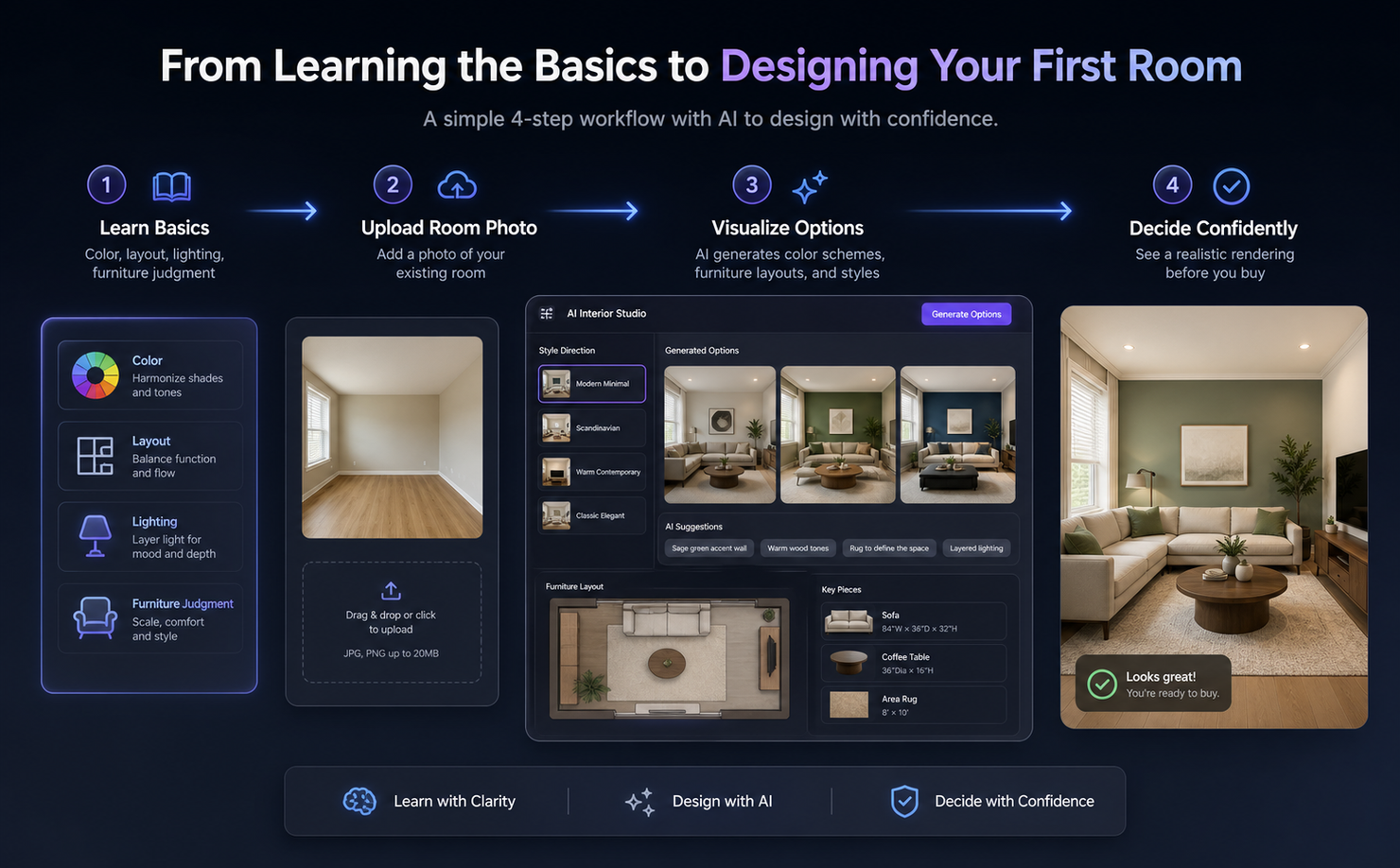
Courses are great for building vocabulary and judgment, but at some point you need to actually see your ideas in a space.
That's where the AI interior design tools like DecAI™ fits in: upload a photo of your room, and its AI-powered visualization turns your new color scheme, furniture arrangement, or style direction into a realistic rendering — before you buy a single thing.
Pairing a beginner course with a visualization tool is one of the fastest ways to go from "I think I like this" to a room you're confident in.
FAQs
1.Are online interior design courses worth it for beginners?
Yes, online interior design courses can be worth it if you choose based on your goal. Short courses are useful for home projects and basic design confidence, while certificate or diploma programs are better for career preparation.
2.Can I learn interior design online with no experience?
Yes. Many beginner courses assume no prior experience. Start with space planning, color, lighting, furniture layout, and mood boards before moving into advanced software or professional certification.
3.What is the best online interior design course?
All of these 15 online courses are good for beginners without any skills or experiences. The courses, like Alison’s Diploma in Interior Design and Oxford Home Study’s Interior Decoration Course are good free starting points. They are best for exploration, not necessarily for full professional training.
4.Do I need a certificate to become an interior designer?
It depends on your location, career goal, and the type of work you want to do. Some decorating work may not require formal credentials, while professional interior design roles may require deeper education, experience, or certification. Always check local requirements.
5.What should I learn first in interior design?
Start with space planning, scale, color, lighting, and function. These fundamentals help you make better design decisions before learning software or buying decor.
6.Can I get an interior design degree fully online?
Yes. Many universities and accredited institutions offer fully online interior design degree programs, allowing you to earn an associate's or bachelor's degree remotely.
However, if your goal is simply to learn interior design skills or start freelancing, a degree isn't always necessary. Many people begin with online courses, build a strong portfolio, and gain practical experience before pursuing professional opportunities.
7.Do I need any design background to start these courses?
No. Every course on this list is either explicitly beginner-level or offers a clear beginner track, so no prior design experience is required.
8.How long does it take to learn interior design basics online?
It depends on the course. Short introductory courses can be completed in a weekend, while certificate and diploma programs typically run anywhere from 16 weeks to two years.
9.Can an online course alone lead to a career in interior design?
It can be a starting point, especially certificate and diploma programs with portfolio components, but most professional roles also value hands-on project experience and, in some regions, formal accreditation.
10.Do I need design software to take a beginner course?
Not usually. Most beginner courses focus on principles first. Software, including AI visualization tools, becomes more useful once you're ready to apply what you've learned to an actual space.
--------------------------------------
If you believe that any material on this site infringes your intellectual property rights, please contact the author at decaiwebteam@outlook.com with details of your claim.
Redesign any home interior, exterior & garden in seconds
Share this Post:
'%3e%3cpath%20d='M17.9995%2035.999C17.0317%2035.999%2016.0619%2035.9219%2015.1161%2035.7696C10.9414%2035.0973%207.11524%2032.9513%204.34408%2029.7273C1.54287%2026.4683%200%2022.3035%200%2017.9995C0%208.07403%208.07503%200%2017.9995%200C27.924%200%2036%208.07503%2036%2017.9995C36%2022.3696%2034.4151%2026.5835%2031.5357%2029.8646C28.6844%2033.1156%2024.7671%2035.2326%2020.5052%2035.8267C19.6806%2035.9419%2018.8371%2036%2017.9995%2036V35.999ZM17.9995%201.20123C8.73726%201.20123%201.20224%208.73626%201.20224%2017.9985C1.20224%2026.2919%207.13427%2033.2659%2015.3075%2034.5814C16.9546%2034.8469%2018.6808%2034.8659%2020.3389%2034.6345C28.5812%2033.4863%2034.7968%2026.334%2034.7968%2017.9985C34.7968%208.73626%2027.2617%201.20123%2017.9985%201.20123H17.9995Z'%20fill='%23FF0209'/%3e%3cpath%20d='M29.0557%2014.3621C28.9184%2013.0276%2028.6208%2011.5539%2027.5268%2010.7784C26.6782%2010.1773%2025.5642%2010.1553%2024.5242%2010.1563C22.3251%2010.1583%2020.126%2010.1603%2017.9269%2010.1623C15.812%2010.1643%2013.6971%2010.1663%2011.5821%2010.1683C10.6985%2010.1683%209.8399%2010.1002%209.01937%2010.4819C8.31406%2010.8105%207.76303%2011.4347%207.43241%2012.1289C6.97156%2013.0957%206.87438%2014.1898%206.81927%2015.2588C6.71708%2017.2044%206.7281%2019.156%206.85133%2021.0996C6.9405%2022.5193%207.16792%2024.0872%208.26496%2024.9919C9.23777%2025.7934%2010.6103%2025.8325%2011.8707%2025.8335C15.8741%2025.8365%2019.8776%2025.8395%2023.881%2025.8435C24.394%2025.8435%2024.93%2025.8345%2025.453%2025.7774C26.4829%2025.6661%2027.4637%2025.3716%2028.1249%2024.6092C28.7922%2023.8407%2028.9635%2022.7698%2029.0657%2021.7569C29.3121%2019.3003%2029.3091%2016.8177%2029.0557%2014.3621ZM15.6116%2021.4453V14.5545L21.5797%2017.9999L15.6116%2021.4453Z'%20fill='%23FF0209'/%3e%3c/g%3e%3cdefs%3e%3cclipPath%20id='clip0_13816_41422'%3e%3crect%20width='36'%20height='36'%20fill='white'/%3e%3c/clipPath%3e%3c/defs%3e%3c/svg%3e)
'%3e%3cpath%20d='M17.9995%2036C17.0327%2036%2016.0619%2035.9229%2015.1161%2035.7696C10.9414%2035.0973%207.11524%2032.9513%204.34408%2029.7273C1.54287%2026.4683%200%2022.3035%200%2017.9995C0%208.07403%208.07503%200%2017.9995%200C27.924%200%2036%208.07503%2036%2017.9995C36%2022.3696%2034.4151%2026.5835%2031.5357%2029.8646C28.6844%2033.1156%2024.7671%2035.2326%2020.5052%2035.8267C19.6806%2035.9419%2018.8371%2036%2017.9995%2036ZM17.9995%201.20224C8.73726%201.20224%201.20224%208.73726%201.20224%2017.9995C1.20224%2026.2919%207.13427%2033.2669%2015.3075%2034.5824C16.9556%2034.8479%2018.6808%2034.8669%2020.3389%2034.6355C28.5812%2033.4873%2034.7968%2026.335%2034.7968%2017.9995C34.7968%208.73726%2027.2617%201.20224%2017.9985%201.20224H17.9995Z'%20fill='url(%23paint0_linear_13816_41436)'/%3e%3cpath%20d='M23.4463%207.55469H12.549C9.53841%207.55469%207.08984%2010.0032%207.08984%2013.0138V22.9834C7.08984%2025.994%209.53841%2028.4426%2012.549%2028.4426H23.4463C26.4569%2028.4426%2028.9054%2025.994%2028.9054%2022.9834V13.0138C28.9054%2010.0032%2026.4569%207.55469%2023.4463%207.55469ZM9.01543%2013.0138C9.01543%2011.0652%2010.6004%209.48027%2012.549%209.48027H23.4463C25.3949%209.48027%2026.9799%2011.0652%2026.9799%2013.0138V22.9834C26.9799%2024.932%2025.3949%2026.517%2023.4463%2026.517H12.549C10.6004%2026.517%209.01543%2024.932%209.01543%2022.9834V13.0138Z'%20fill='url(%23paint1_linear_13816_41436)'/%3e%3cpath%20d='M17.9964%2023.0749C20.7966%2023.0749%2023.0749%2020.7966%2023.0749%2017.9964C23.0749%2015.1962%2020.7966%2012.918%2017.9964%2012.918C15.1962%2012.918%2012.918%2015.1962%2012.918%2017.9964C12.918%2020.7966%2015.1962%2023.0749%2017.9964%2023.0749ZM17.9964%2014.8446C19.7346%2014.8446%2021.1483%2016.2582%2021.1483%2017.9964C21.1483%2019.7347%2019.7346%2021.1483%2017.9964%2021.1483C16.2582%2021.1483%2014.8446%2019.7347%2014.8446%2017.9964C14.8446%2016.2582%2016.2582%2014.8446%2017.9964%2014.8446Z'%20fill='url(%23paint2_linear_13816_41436)'/%3e%3cpath%20d='M23.5482%2013.741C24.3026%2013.741%2024.9168%2013.1269%2024.9168%2012.3725C24.9168%2011.618%2024.3026%2011.0039%2023.5482%2011.0039C22.7938%2011.0039%2022.1797%2011.618%2022.1797%2012.3725C22.1797%2013.1269%2022.7938%2013.741%2023.5482%2013.741Z'%20fill='url(%23paint3_linear_13816_41436)'/%3e%3c/g%3e%3cdefs%3e%3clinearGradient%20id='paint0_linear_13816_41436'%20x1='5.27482'%20y1='30.7312'%20x2='30.7242'%20y2='5.28083'%20gradientUnits='userSpaceOnUse'%3e%3cstop%20stop-color='%23FAAD4F'/%3e%3cstop%20offset='0.35'%20stop-color='%23DD2A7B'/%3e%3cstop%20offset='0.62'%20stop-color='%239537B0'/%3e%3cstop%20offset='1'%20stop-color='%23515BD4'/%3e%3c/linearGradient%3e%3clinearGradient%20id='paint1_linear_13816_41436'%20x1='8.92225'%20y1='27.074'%20x2='27.073'%20y2='8.92324'%20gradientUnits='userSpaceOnUse'%3e%3cstop%20stop-color='%23FAAD4F'/%3e%3cstop%20offset='0.35'%20stop-color='%23DD2A7B'/%3e%3cstop%20offset='0.62'%20stop-color='%239537B0'/%3e%3cstop%20offset='1'%20stop-color='%23515BD4'/%3e%3c/linearGradient%3e%3clinearGradient%20id='paint2_linear_13816_41436'%20x1='14.4077'%20y1='21.5861'%20x2='21.5861'%20y2='14.4077'%20gradientUnits='userSpaceOnUse'%3e%3cstop%20stop-color='%23FAAD4F'/%3e%3cstop%20offset='0.35'%20stop-color='%23DD2A7B'/%3e%3cstop%20offset='0.62'%20stop-color='%239537B0'/%3e%3cstop%20offset='1'%20stop-color='%23515BD4'/%3e%3c/linearGradient%3e%3clinearGradient%20id='paint3_linear_13816_41436'%20x1='22.5814'%20y1='13.3393'%20x2='24.515'%20y2='11.4057'%20gradientUnits='userSpaceOnUse'%3e%3cstop%20stop-color='%23FAAD4F'/%3e%3cstop%20offset='0.35'%20stop-color='%23DD2A7B'/%3e%3cstop%20offset='0.62'%20stop-color='%239537B0'/%3e%3cstop%20offset='1'%20stop-color='%23515BD4'/%3e%3c/linearGradient%3e%3cclipPath%20id='clip0_13816_41436'%3e%3crect%20width='36'%20height='36'%20fill='white'/%3e%3c/clipPath%3e%3c/defs%3e%3c/svg%3e)
'%3e%3cpath%20d='M17.9995%2035.999C17.0317%2035.999%2016.0619%2035.9219%2015.1161%2035.7696C10.9414%2035.0973%207.11524%2032.9513%204.34408%2029.7273C1.54287%2026.4683%200%2022.3035%200%2017.9995C0%208.07403%208.07502%200%2017.9995%200C27.924%200%2036%208.07503%2036%2017.9995C36%2022.3696%2034.415%2026.5835%2031.5357%2029.8646C28.6844%2033.1156%2024.7671%2035.2326%2020.5052%2035.8267C19.6806%2035.9419%2018.8371%2036%2017.9995%2036V35.999ZM17.9995%201.20123C8.73725%201.20123%201.20224%208.73626%201.20224%2017.9985C1.20224%2026.2919%207.13427%2033.2659%2015.3075%2034.5814C16.9545%2034.8469%2018.6808%2034.8659%2020.3388%2034.6345C28.5812%2033.4863%2034.7968%2026.334%2034.7968%2017.9985C34.7968%208.73626%2027.2617%201.20123%2017.9985%201.20123H17.9995Z'%20fill='%23007EBB'/%3e%3cpath%20d='M9.06639%2012.124C8.60253%2011.6932%208.37109%2011.1602%208.37109%2010.526C8.37109%209.89184%208.60253%209.33481%209.06639%208.90401C9.53026%208.47321%2010.1274%208.25781%2010.8587%208.25781C11.5901%208.25781%2012.1642%208.47321%2012.627%208.90401C13.0909%209.33481%2013.3223%209.87581%2013.3223%2010.526C13.3223%2011.1762%2013.0909%2011.6932%2012.627%2012.124C12.1631%2012.5548%2011.5741%2012.7702%2010.8587%2012.7702C10.1434%2012.7702%209.52926%2012.5548%209.06639%2012.124ZM12.9326%2014.5946V27.7962H8.76182V14.5946H12.9326Z'%20fill='%23007EBB'/%3e%3cpath%20d='M26.8196%2015.9006C27.7283%2016.8875%2028.1832%2018.243%2028.1832%2019.9682V27.5663H24.2208V20.5042C24.2208%2019.6346%2023.9954%2018.9583%2023.5445%2018.4764C23.0937%2017.9945%2022.4876%2017.7541%2021.7262%2017.7541C20.9647%2017.7541%2020.3586%2017.9955%2019.9078%2018.4764C19.4569%2018.9583%2019.2315%2019.6346%2019.2315%2020.5042V27.5663H15.2461V14.5611H19.2315V16.2863C19.6353%2015.7113%2020.1793%2015.2574%2020.8636%2014.9228C21.5468%2014.5892%2022.3163%2014.4219%2023.1708%2014.4219C24.6937%2014.4219%2025.9099%2014.9158%2026.8186%2015.9016L26.8196%2015.9006Z'%20fill='%23007EBB'/%3e%3c/g%3e%3cdefs%3e%3cclipPath%20id='clip0_13816_41425'%3e%3crect%20width='36'%20height='36'%20fill='white'/%3e%3c/clipPath%3e%3c/defs%3e%3c/svg%3e)
'%3e%3cpath%20d='M18%2035.999C17.0322%2035.999%2016.0623%2035.9219%2015.1166%2035.7696C10.9417%2035.0973%207.11544%2032.9513%204.3442%2029.7273C1.54291%2026.4683%200%2022.3035%200%2017.9995C0%208.07403%208.07526%200%2018%200C27.9248%200%2036%208.07503%2036%2017.9995C36%2022.3696%2034.415%2026.5835%2031.5356%2029.8646C28.6842%2033.1156%2024.7668%2035.2326%2020.5047%2035.8267C19.6802%2035.9419%2018.8366%2036%2017.999%2036L18%2035.999ZM18%201.20123C8.73751%201.20123%201.20227%208.73626%201.20227%2017.9985C1.20227%2026.2919%207.13448%2033.2659%2015.3079%2034.5814C16.955%2034.8469%2018.6813%2034.8659%2020.3394%2034.6345C28.582%2033.4863%2034.7977%2026.334%2034.7977%2017.9985C34.7977%208.73626%2027.2625%201.20123%2018%201.20123Z'%20fill='black'/%3e%3cpath%20d='M7%208.09163H13.5067L19.521%2016.1816L27.0073%207.90625L28.786%207.93715L20.4078%2017.3454L29%2028.901H22.4959L16.8193%2021.362L9.8847%2029.0864H8.13428L15.9583%2020.26L7%208.09163ZM12.8931%209.28633H9.45676L23.2048%2027.6754H26.5793L12.8931%209.28633Z'%20fill='black'/%3e%3c/g%3e%3cdefs%3e%3cclipPath%20id='clip0_13886_43848'%3e%3crect%20width='36'%20height='36'%20fill='white'/%3e%3c/clipPath%3e%3c/defs%3e%3c/svg%3e)
'%3e%3cpath%20d='M17.9995%2035.999C17.0327%2035.999%2016.0619%2035.9219%2015.1161%2035.7686C10.9414%2035.0963%207.11524%2032.9503%204.34408%2029.7263C1.54287%2026.4673%200%2022.3025%200%2017.9995C0%208.07403%208.07503%200%2017.9995%200C27.924%200%2036%208.07503%2036%2017.9995C36%2022.3696%2034.415%2026.5835%2031.5357%2029.8646C28.6844%2033.1156%2024.7671%2035.2326%2020.5052%2035.8267C19.6806%2035.9419%2018.8371%2036%2017.9995%2036V35.999ZM17.9995%201.20123C8.73726%201.20123%201.20224%208.73626%201.20224%2017.9985C1.20224%2026.2909%207.13428%2033.2659%2015.3075%2034.5814C16.9556%2034.8469%2018.6808%2034.8659%2020.3389%2034.6345C28.5812%2033.4863%2034.7968%2026.334%2034.7968%2017.9985C34.7968%208.73626%2027.2617%201.20123%2017.9985%201.20123H17.9995Z'%20fill='%231877F7'/%3e%3cpath%20d='M20.5337%2014.9635V18.7536H25.2225L24.4801%2023.8601H20.5337V35.624C19.7423%2035.7342%2018.9328%2035.7913%2018.1112%2035.7913C17.1625%2035.7913%2016.2317%2035.7151%2015.324%2035.5689V23.8601H11V18.7536H15.324V14.1169C15.324%2011.2396%2017.6564%208.90625%2020.5347%208.90625V8.90926C20.5428%208.90926%2020.5508%208.90625%2020.5588%208.90625H25.2235V13.3215H22.1758C21.2691%2013.3215%2020.5347%2014.0558%2020.5347%2014.9625L20.5337%2014.9635Z'%20fill='%231877F7'/%3e%3c/g%3e%3cdefs%3e%3cclipPath%20id='clip0_13816_41433'%3e%3crect%20width='36'%20height='36'%20fill='white'/%3e%3c/clipPath%3e%3c/defs%3e%3c/svg%3e)
'%3e%3cpath%20d='M17.9995%2035.999C17.0327%2035.999%2016.0619%2035.9219%2015.1161%2035.7686C10.9414%2035.0963%207.11524%2032.9503%204.34408%2029.7263C1.54287%2026.4673%200%2022.3025%200%2017.9995C0%208.07403%208.07503%200%2017.9995%200C27.924%200%2036%208.07503%2036%2017.9995C36%2022.3696%2034.415%2026.5835%2031.5357%2029.8646C28.6844%2033.1156%2024.7671%2035.2326%2020.5052%2035.8267C19.6806%2035.9419%2018.8371%2036%2017.9995%2036V35.999ZM17.9995%201.20123C8.73726%201.20123%201.20224%208.73626%201.20224%2017.9985C1.20224%2026.2909%207.13428%2033.2659%2015.3075%2034.5814C16.9556%2034.8469%2018.6808%2034.8659%2020.3389%2034.6345C28.5812%2033.4863%2034.7968%2026.334%2034.7968%2017.9985C34.7968%208.73626%2027.2617%201.20123%2017.9985%201.20123H17.9995Z'%20fill='%232A91F7'/%3e%3cg%20clip-path='url(%23clip1_13816_41442)'%3e%3cpath%20d='M16.3345%2018.834C16.6924%2019.3124%2017.149%2019.7083%2017.6733%2019.9947C18.1976%2020.2812%2018.7774%2020.4516%2019.3734%2020.4942C19.9693%2020.5369%2020.5675%2020.4509%2021.1273%2020.2421C21.6871%2020.0333%2022.1954%2019.7065%2022.6178%2019.284L25.1178%2016.784C25.8768%2015.9981%2026.2968%2014.9456%2026.2873%2013.8531C26.2778%2012.7606%2025.8396%2011.7156%2025.0671%2010.943C24.2946%2010.1705%2023.2495%209.73231%2022.157%209.72281C21.0645%209.71332%2020.012%2010.1333%2019.2262%2010.8923L17.7928%2012.3173M19.6678%2017.1673C19.3099%2016.6889%2018.8533%2016.293%2018.329%2016.0065C17.8047%2015.7201%2017.2249%2015.5497%2016.6289%2015.507C16.033%2015.4643%2015.4348%2015.5503%2014.875%2015.7592C14.3152%2015.968%2013.8069%2016.2947%2013.3845%2016.7173L10.8845%2019.2173C10.1255%2020.0031%209.70551%2021.0557%209.715%2022.1481C9.72449%2023.2406%2010.1627%2024.2857%2010.9352%2025.0582C11.7078%2025.8307%2012.7528%2026.269%2013.8453%2026.2784C14.9378%2026.2879%2015.9903%2025.868%2016.7761%2025.109L18.2011%2023.684'%20stroke='%232A91F7'%20stroke-width='1.66667'%20stroke-linecap='round'%20stroke-linejoin='round'/%3e%3c/g%3e%3c/g%3e%3cdefs%3e%3cclipPath%20id='clip0_13816_41442'%3e%3crect%20width='36'%20height='36'%20fill='white'/%3e%3c/clipPath%3e%3cclipPath%20id='clip1_13816_41442'%3e%3crect%20width='20'%20height='20'%20fill='white'%20transform='translate(8%208)'/%3e%3c/clipPath%3e%3c/defs%3e%3c/svg%3e)
Redesign any home interior, exterior & garden in seconds